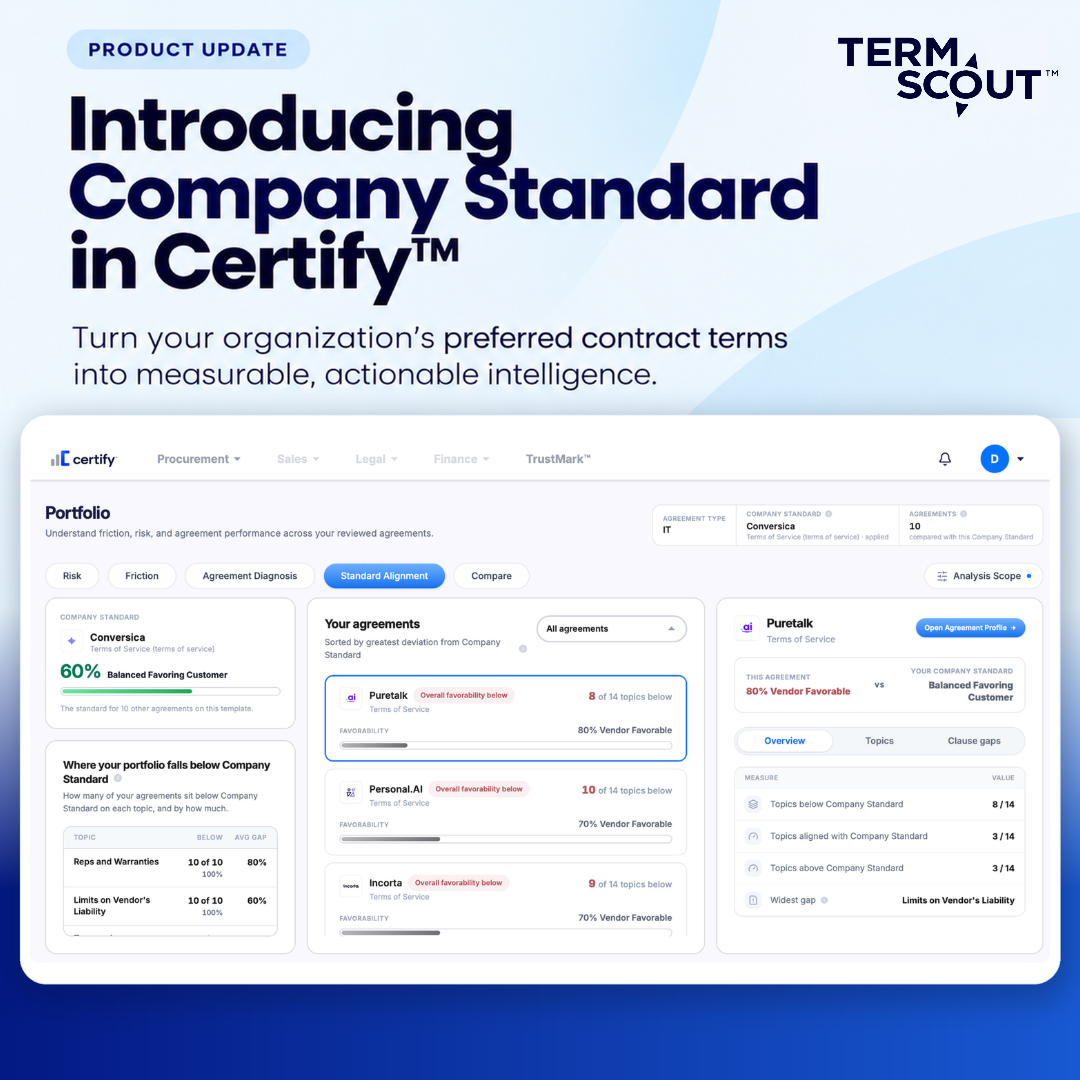
New capability helps Procurement and Legal teams compare agreements against their organization’s selected standards, and make consistent contracting decisions.
SAN FRANCISCO, CA, UNITED STATES, October 27, 2026 /EINPresswire.com/ — TermScout today announced Company Standard in the Certify™ Procurement View, helping Procurement and Legal teams compare agreements with their organization’s selected reference agreement for each supported Agreement Type.
Through Portfolio’s Standard Alignment capability, teams can identify agreements with the greatest deviations from that reference and investigate differences across Topics and Clause gaps. The comparison helps teams focus review and prepare for negotiation or renewal. A Company Standard represents the organization’s chosen reference. Teams review the underlying findings and apply their own approval and exception procedures when deciding how to act.
Turning Preferred Contract Terms Into Measurable Intelligence
Organizations often invest significant time developing contract templates and negotiating preferred positions. But establishing a standard is only the beginning. The greater challenge is understanding whether those positions are consistently reflected in agreements across the business.
Company Standard addresses this challenge by allowing organizations to select an existing agreement as their reference for a particular Agreement Type.
Through Certify’s Standard Alignment capability, teams can then:
• Establish an internal reference: Designate a Company Standard for each supported Agreement Type.
• Measure alignment: Understand how selected agreements compare with the organization’s chosen standard.
• Identify deviations: See which contractual Topics fall below, align with, or exceed the reference agreement’s positions.
• Investigate clause-level differences: Explore the specific provisions and clause gaps behind deviations.
• Prioritize review: Identify agreements with the greatest differences from the selected Company Standard for further investigation.
Rather than relying solely on manual comparisons or institutional knowledge, Procurement and Legal teams gain a structured view of where their agreements differ from their preferred contractual positions.
The goal is not to eliminate exceptions or require identical contract language in every negotiation. It is to make those differences visible, understandable, and easier to evaluate.
From Contract Standards to Consistent Decisions
“A company can spend months developing preferred contract terms and still struggle to see where its signed agreements differ,” said Olga V. Mack, CEO of TermScout. “Those differences give Procurement and Legal a practical place to start: which agreements need attention, which exceptions keep recurring, and what should we revisit at renewal? Company Standard makes the comparison visible so teams can investigate the findings and decide what to do next.”
For Procurement teams, this creates an opportunity to examine whether negotiated vendor agreements reflect internal contracting expectations and identify recurring deviations that may warrant further attention.
For Legal teams, it provides a more structured way to review contractual consistency, examine exceptions, and focus their expertise on differences that may have meaningful business or legal implications.
For business leaders, greater visibility into contract positions supports more informed conversations about organizational risk, negotiation priorities, and contracting practices.
Connecting Internal Standards With Market Intelligence
Company Standard builds on TermScout’s broader approach to contract intelligence by connecting an organization’s internal contract expectations with the external market context available through Certify™.
These two perspectives answer different questions:
• Company Standard helps organizations understand how their agreements compare with the reference positions they have selected internally.
Market helps organizations understand how their contract positions compare with those found in comparable real-world agreements.
• Portfolio helps organizations identify concentrations of Risk and potential negotiation Friction across selected agreements, investigate contributing clauses, and identify the contracts behind key findings.
Together, these capabilities give Procurement and Legal teams complementary perspectives on contractual positions: what the organization prefers, what its agreements contain, and how those positions compare with available market evidence. An agreement that differs from an internal standard does not necessarily represent unacceptable risk. Similarly, a position commonly found in the market is not automatically appropriate for every organization.
By providing both forms of comparison, Certify helps teams investigate differences and apply their own judgment to determine which issues deserve attention.
Learn how Certify™ helps your organization understand contract risk, market alignment, and internal standards at www.TermScout.com.
About TermScout
TermScout is a contract intelligence and certification platform that helps Legal, Procurement, and Sales teams understand agreements, compare contract positions, and make more informed contracting decisions.
Through Certify™, TermScout turns contract terms into structured intelligence, enabling organizations to evaluate contractual risk, identify portfolio-level patterns, and compare agreements against internal standards and real-world market data.
Its TrustMark™ certification provides independent verification of qualifying agreements, helping organizations demonstrate contractual trust and accelerate commercial decisions.
For more information, visit www.TermScout.com.
Renee Donis
TermScout
3033512608 ext.
Visit us on social media:
LinkedIn
YouTube
Legal Disclaimer:
EIN Presswire provides this news content “as is” without warranty of any kind. We do not accept any responsibility or liability
for the accuracy, content, images, videos, licenses, completeness, legality, or reliability of the information contained in this
article. If you have any complaints or copyright issues related to this article, kindly contact the author above.

Media gallery