The Business Research Company’s Spatial Genomics Global Market Report 2026 – Market Size, Trends, And Forecast 2026-2035
LONDON, GREATER LONDON, UNITED KINGDOM, September 14, 2026 /EINPresswire.com/ — The spatial genomics market is emerging as a key area of interest within the genomics and biomedical research landscape. With its capacity to map gene activity in precise tissue contexts, this market is experiencing strong momentum and holds promising prospects for the coming years. Below, we delve into the market’s current valuation, driving factors, regional outlook, and key trends shaping its future.
Spatial Genomics Market Value and Growth Trajectory
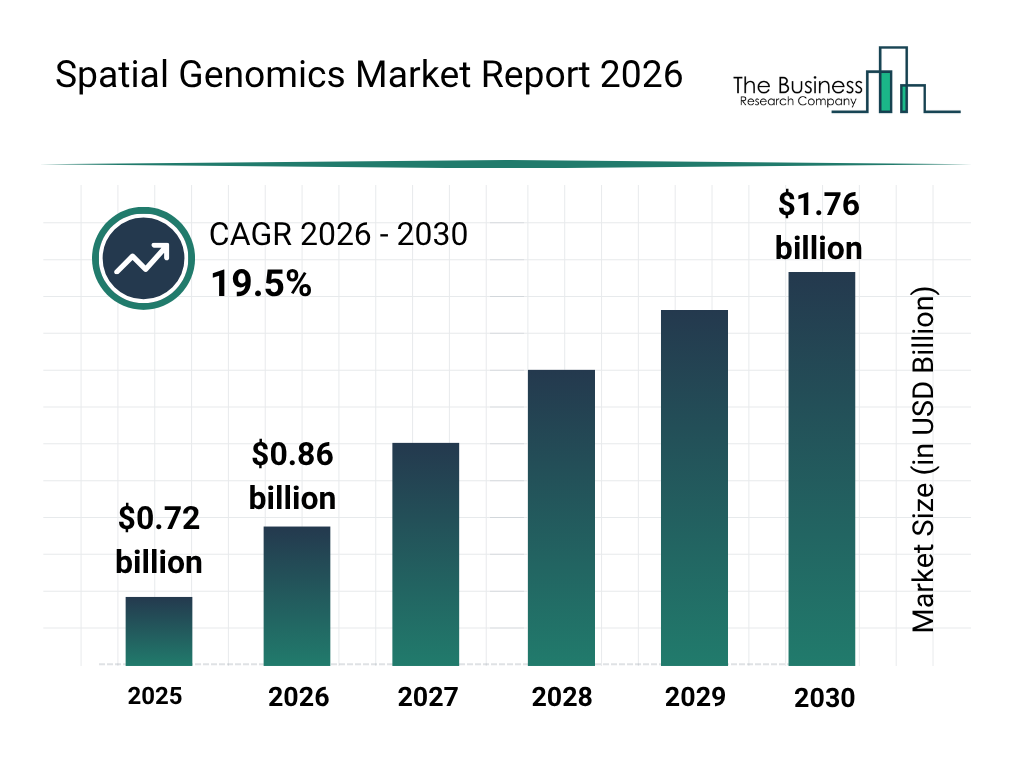
The spatial genomics market has seen rapid expansion recently and is projected to continue this trend. Market size is expected to rise from $0.72 billion in 2025 to $0.86 billion in 2026, representing a compound annual growth rate (CAGR) of 20.0%. This growth up to now has been driven by the increasing adoption of next-generation sequencing technologies, a growing emphasis on precision medicine research, expanded funding for genomics studies at academic institutions, the proliferation of molecular biology labs, and a surge in cancer-related research.
Download a free sample of the spatial genomics market report:
https://thebusinessresearchcompany.com/sample_request?id=82940008&type=smp&name=Spatial%20Genomics%20Market%20Report%202026&utm_source=EINPresswire&utm_medium=Paid&utm_campaign=Sep_PR
Looking ahead, the market is set for even more accelerated growth, reaching $1.76 billion by 2030 with a CAGR of 19.5%. This anticipated expansion is fueled by advancements in AI-powered spatial genomics data analysis, rising demand for personalized medicine and targeted therapies, greater integration of multiomics platforms, development of cloud-based biomedical data infrastructure, and wider use of spatial biology in drug discovery pipelines. Key trends expected to influence the market include the adoption of spatial multiomics for fine-scale tissue mapping across disease studies, growing applications of spatial transcriptomics in oncology and neuroscience, broader use of AI-driven bioinformatics to interpret spatial gene expression, expansion of cloud genomic data storage and collaboration, and enhanced imaging-sequencing integration to improve tissue analysis.
Understanding Spatial Genomics Technology
Spatial genomics represents a cutting-edge approach in genomic analysis that allows scientists to visualize gene activity within the physical context of cells and tissues. By merging sequencing methods, molecular profiling, and imaging techniques, this technology provides detailed insight into the spatial arrangement, organization, and interactions of genetic material within biological samples. This spatially resolved information is crucial for deepening understanding of cellular function, disease development, and tissue structure, as it preserves the location-specific data often lost in traditional genomic techniques.
View the full spatial genomics market report:
https://www.thebusinessresearchcompany.com/report/spatial-genomics-market-report?utm_source=EINPresswire&utm_medium=Paid&utm_campaign=Sep_PR
Key Factors Fueling Spatial Genomics Market Expansion
One of the main drivers pushing the spatial genomics market forward is the growing implementation of precision medicine. Precision medicine tailors medical treatments to individual patient profiles, including genetic makeup, biomarkers, and disease characteristics. Advances in biomarker discovery and molecular diagnostics have improved the ability to classify diseases more accurately and select targeted therapies. Spatial genomics plays a vital role in this process by mapping gene expression and cellular interactions in their tissue context, aiding biomarker identification, revealing disease variability, and guiding the creation of personalized treatments. For example, the Personalized Medicine Coalition reported that in 2023, the FDA approved 16 new personalized therapies for rare diseases in the U.S., a significant increase compared to six approvals in 2022. This trend towards precision medicine is a key catalyst for growth in the spatial genomics sector.
Regional Dynamics in the Spatial Genomics Market
In terms of geographic distribution, North America held the largest share of the spatial genomics market in 2025. Meanwhile, the Asia-Pacific region is projected to experience the fastest growth over the forecast period. The comprehensive market report encompasses regions including Asia-Pacific, South East Asia, Western Europe, Eastern Europe, North America, South America, the Middle East, and Africa, providing a broad view of global market trends and regional developments shaping the spatial genomics landscape.
New analytical features added to our 2026 market reports:
• Market attractiveness scoring and analysis
• Total addressable market (TAM) analysis
• Company scoring matrix graphics and tables
• Excel-based forecasting dashboards
• Market hotspots infographics
• Key technologies and future trend analysis
• Updated graphics and tables
Speak With Our Expert:
Saumya Sahay
Americas +1 310-496-7795
Asia +44 7882 955267 & +91 8897263534
Europe +44 7882 955267
Email: marketing@tbrc.info
The Business Research Company – www.thebusinessresearchcompany.com
Follow Us On:
• LinkedIn: https://in.linkedin.com/company/the-business-research-company
Oliver Guirdham
The Business Research Company
+ +44 7882 955267
email us here
Visit us on social media:
LinkedIn
Facebook
X
Legal Disclaimer:
EIN Presswire provides this news content “as is” without warranty of any kind. We do not accept any responsibility or liability
for the accuracy, content, images, videos, licenses, completeness, legality, or reliability of the information contained in this
article. If you have any complaints or copyright issues related to this article, kindly contact the author above.

Media gallery