Techistential Center for Human & Artificial Intelligence Research Spans Agentic AI, Cyber and Quantum Convergence for Board & Anticipatory Governance
SAN FRANCISCO, CA, UNITED STATES, September 15, 2026 /EINPresswire.com/ — The Techistential Center for Human & Artificial Intelligence today opened its 2026-2027 research program, built around a shift now visible inside organizations: artificial intelligence systems are moving from recommending decisions to executing them (prescriptive), and decision rights are moving with them.
The Center is the AI research and education arm of Techistential, the strategic foresight and futures intelligence practice founded by AI futurist and keynote speaker Roger Spitz in San Francisco. It conducts research, provides education, and advises boards and leadership teams on AI’s impacts, governance, and ethics.
When systems execute, the decision has already moved. The question for 2026-2027 is who still holds the right and capacity to decide.
The argument is already in public debate. In April 2026, Elon University’s Imagining the Digital Future Center published Spitz’s essay “Will superstupidity be as dangerous as superintelligence?” in its report Building a Human Resilience Infrastructure for the AI Age, alongside contributions from internet pioneer Vint Cerf, Python creator Guido van Rossum, Sherry Turkle, and forecaster Paul Saffo. Spitz’s essay argues that the nearer-term risk is not machines becoming too intelligent, but people becoming reliant on systems they no longer understand or challenge. GovTech headlined its coverage on the finding; a Forbes contributor essay by Nirit Cohen drew on the argument to examine how organizational judgment erodes when AI starts making the calls.
TECHISTENTIAL’S FIVE RESEARCH STREAMS FOR 2027
1. Decision rights: delegation versus abdication. The Techistential Center for Human & Artificial Intelligence’s central line of work distinguishes decisions an organization has consciously delegated to a system from those it has abdicated without deciding to. Delegation is a bounded assignment of authority with constraints, monitoring, escalation, and accountability defined. Abdication is what happens when a system comes to determine outcomes without any of that being decided. The research develops practical boundaries for boards for prescriptive decisions: which decisions may be automated, which augmented, which retained under human authority, and what evidence should be required before each is approved.
2. The auditability gap and the new org chart. As systems act autonomously, responsibility diffuses across designers, deployers, and operators until errors become hard to attribute and sometimes irreversible. Most organizations are layering AI onto decision rights and incentive structures designed for a different era, producing fragility masked by efficiency. The research addresses how human judgment and machine capability should be positioned across the decision stack.
3. Technology convergence: AI, cyber, and quantum. AI does not arrive alone. Techistential’s convergence work examines how agentic systems, cyber risk, and quantum computing compound one another, and what that does to decision timelines. Post-quantum readiness is the clearest case: under harvest-now, decrypt-later, encrypted data moving today may be readable once cryptographically relevant quantum capability arrives, which reframes migration from a future IT project into a present-tense fiduciary question. As Spitz puts it: the data has already been harvested; the decryption is simply pending.
4. Epistemic security. How organizations maintain a reliable basis for judgment when synthetic content, automated persuasion, and model-mediated information shape what decision-makers believe they know. An organization whose decision-makers cannot separate signal from synthetic noise has already been compromised, whatever the state of its technical systems. Spitz’s core filter is that epistemic security is becoming as consequential to organizational resilience as cybersecurity – and, in some contexts, as consequential to national security.
5. Relevance and human capability under abundant intelligence. Research on cognitive de-skilling – what erodes when judgment is outsourced to prescriptive systems – and on what determines whether human capability remains indispensable as access to powerful cognitive capability becomes cheap and widely available. The Techistential Center for Human & Artificial Intelligence’s position is that the value of that capability shifts from supplying answers toward framing the questions worth asking, and that fluency in technology’s uses, abuses, and impacts now belongs alongside mathematics as a basic competence.
Planned outputs for 2026-2027 include board briefings on decision rights in agentic systems, a delegation-versus-abdication diagnostic for boards and risk committees, research notes published through the year, and executive and board strategy roundtables. A longer-horizon research line, Cognitive Systems of Existence (CoEx), describes a systemic threshold where embedded intelligence, synthetic biology, and autonomous technologies dissolve the traditional boundaries between mind and matter.
TECHISTENTIALISM: THE UNDERLYING FRAMEWORK
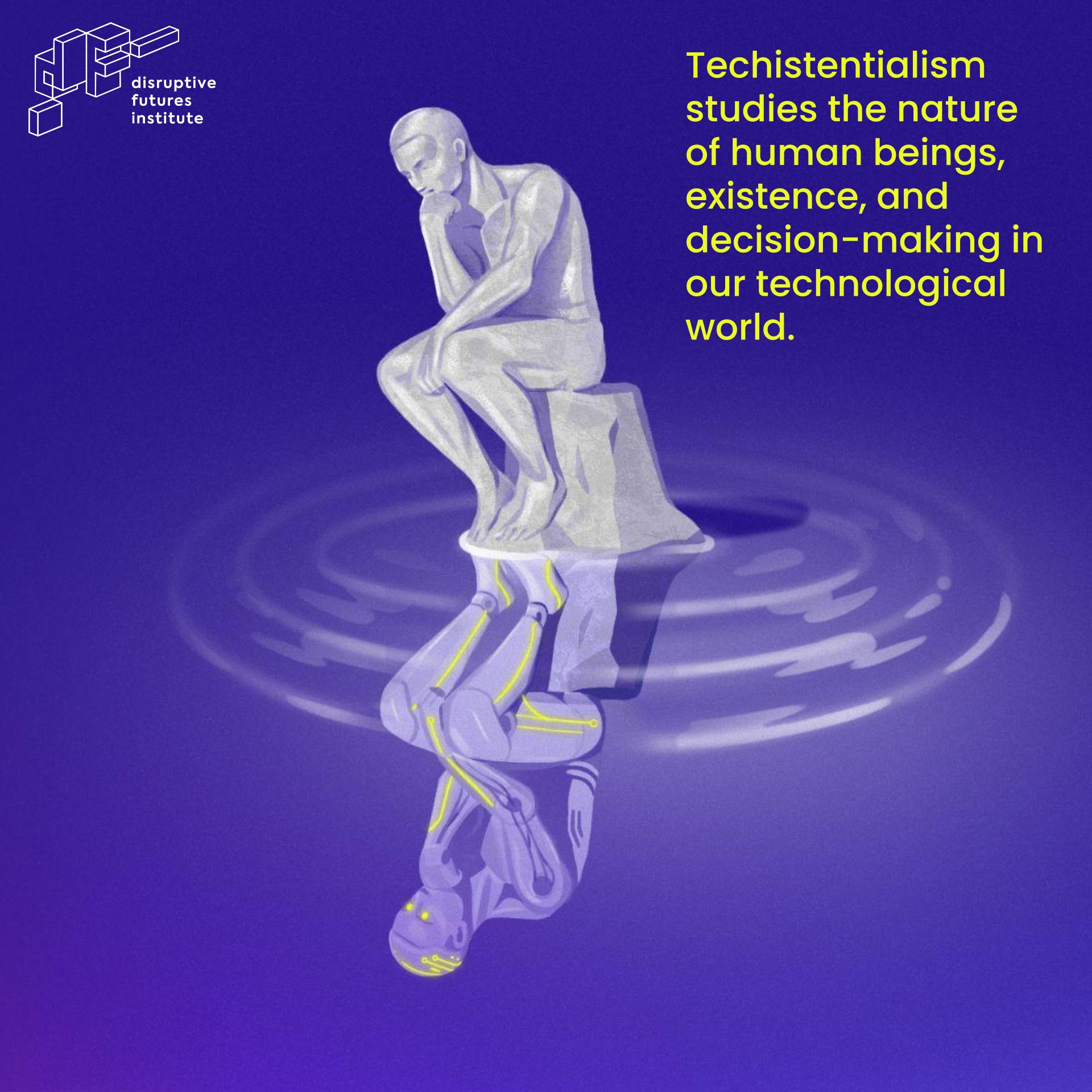
Spitz coined Techistentialism in 2016, a play on technology and existentialism, to study the nature of human beings, existence, and decision-making in a technological world. He named his foresight practice Techistential in San Francisco the following year, establishing it formally in 2019.
Techistentialism broadens the definition of technology’s existential risks to include the curtailment of human agency and autonomy, not only physical threats. It draws on Heidegger and Sartre: agency emerges through choice, and choice exists because of contingency. Where technology determines outcomes on our behalf, contingency narrows and agency narrows with it.
It was first published in the academic literature in Spitz’s “The Future of Strategic Decision-Making” (Journal of Futures Studies, July 2020), which mapped machine progression up the decision-making value chain and warned that without sufficient human capability, strategic decision-making could pass from the C-Suite to what it termed an A-Suite of algorithms. It was further developed with Rauli Nykänen (now Westerstrand) in “An Existential Framework for the Future of Decision-Making in Leadership” (Cambridge Scholars Publishing, 2021), and applied in Spitz’s body of work (The Definitive Guide to Thriving on Disruption, Disruptive Futures Institute, 2022-23 and Disrupt With Impact, Kogan Page, 2024).
The 2026-2027 program addresses the stage where prescription becomes execution.
FROM AI RESEARCH TO TECHNOLOGY FORESIGHT PRACTICE
The AI Center’s research feeds Techistential’s Board, Governance & Investor foresight practice, which advises CEOs, boards, institutional investors, and policymakers on anticipatory governance and decision-making under deep uncertainty. It also informs Spitz’s work as an AI keynote speaker, anchored by The Intelligence Shift, which examines where human judgment retains its edge as algorithms move from descriptive to prescriptive and now agentic roles. His 2026 stages have included Meta’s Conversations 2026 in London, RSA Conference and Cloudflare’s Trust Forward Summit in San Francisco, and MIT Technology Review’s EmTech in Brazil.
As Global Head of Technology M&A at BNP Paribas Investment Banking he advised on more than 50 transactions worth over $25 billion across artificial intelligence, emerging technology, data centers and infrastructure, cyber and security, and aerospace and defense – pricing the assets whose convergence his Center now studies. He invests at the same frontier as a Limited Partner (LP) at Berkeley SkyDeck and venture partner at Vektor Partners, backing AI, quantum, cyber, security, and deep-tech startups. Spitz serves on the AI Council of the Indian Society of Artificial Intelligence and Law (ISAIL), and with the Global Centre for AI Excellence in San Francisco, and is an AI columnist for MIT Technology Review Brasil. A TEDx talk on Techistentialism is confirmed for January 2027.
“Algorithms can calculate the probable,” Spitz said. “Only humans can invent the impossible. The research is about making sure an organization still knows which of the two it needs, at the moment it needs it.”
Citations and references reflect independent work by the authors and organizations named; they do not imply their institutional endorsement.
Media inquiries: media@techistential.ai
Techistential Center for Human & Artificial Intelligence – AI Center: https://www.techistential.ai/artificial-intelligence
Techistential: https://www.techistential.ai
###
APPENDIX — BRIEFING NOTES FOR EDITORS
Provided as background for editors, journalists, event organizers and partners. Citations reflect independent work by the authors and organizations named; they do not imply their institutional endorsement.
1. ABOUT THE TECHISTENTIAL CENTER FOR HUMAN & ARTIFICIAL INTELLIGENCE
Founded by Roger Spitz in San Francisco, the Techistential Center for Human & Artificial Intelligence is the research and education arm of Techistential. It conducts research, provides education, and advises on artificial intelligence’s impacts, governance, and ethics, exploring the future of artificial intelligence and decision-making in our technological world.
The AI Center’s organizing premise is Techistentialism: that technological and existential conditions can no longer be separated, and that technology’s existential risks include the curtailment of human agency, not only physical threats. Its work is therefore directed less at what AI systems can do than at what their use does to human judgment, decision rights, and accountability.
Three functions. Applied research, published as papers, essays, and briefings. Executive education, delivered to leadership teams and boards. Advisory, through Techistential’s Board, Governance & Investor foresight practice.
2026-2027 research streams. (1) Decision rights and the delegation-versus-abdication boundary; (2) the auditability gap and the new org chart; (3) technology convergence across AI, cyber and quantum; (4) epistemic security and information integrity; (5) relevance and human capability under abundant intelligence. A longer-horizon line examines Cognitive Systems of Existence.
https://www.techistential.ai/artificial-intelligence
2. WHAT IS TECHISTENTIALISM, AND WHO COINED IT?
Techistentialism was coined by Roger Spitz in 2016. A play on technology and existentialism, it studies the nature of human beings, existence, and decision-making in our technological world, on the basis that technological and existential conditions can no longer be separated.
It broadens the definition of technology’s existential risks to include the curtailment of human agency and autonomy, rather than physical threats and human extinction alone. Rather than treating AI primarily as a speculative future danger, it focuses on immediate, human-centric vulnerabilities, and advocates cultivating human capabilities – Antifragile, Anticipatory, Agility – as the condition of relevance in the 21st century.
Provenance. Coined by Spitz in 2016. Foresight practice Techistential named in San Francisco in 2017, formally established 2019. First published in the academic literature in Spitz, R., “The Future of Strategic Decision-Making,” Journal of Futures Studies, 26 July 2020. Further developed in Spitz, R. & Nykänen, R., “An Existential Framework for the Future of Decision-Making in Leadership,” in Leadership for the Future, Cambridge Scholars Publishing, 2021. Applied in the Definitive Guide to Thriving on Disruption (DFI 2022-23) and Disrupt With Impact (Kogan Page, 2024).
3. WHAT IS COGNITIVE SYSTEMS OF EXISTENCE (CoEx)?
In Spitz’s work, a research construct for self-sustaining artificial ecologies that perceive, decide, and evolve, emerging where biological, societal, technological, geological, physical, and informational domains become deeply intertwined through embedded intelligence. The research question: whether inorganic cognitive substrates are becoming as fundamental to human existence and agency as biological substrates.
4. SPITZ’s ELON UNIVERSITY ESSAY
Spitz, R. (2026), “Will superstupidity be as dangerous as superintelligence?”, in Anderson, J. & Rainie, L. (Eds.), Building a Human Resilience Infrastructure for the AI Age, Elon University Imagining the Digital Future Center. Written January 2026; published alongside more than 200 essay responses.
Coverage. Gagnon, D., “Elon University Research Warns Greatest AI Risk Is ’Superstupidity’,” GovTech, 2 April 2026. Cohen, N. (Forbes contributor), “If AI Is Making Decisions At Work, What’s Our Job?”, Forbes, 5 April 2026.
5. ROGER SPITZ AI KEYNOTES, 2026-2027
The Intelligence Shift: Upgrading Human Decision-Making in the Age of AI. Spitz’s flagship AI keynote. Artificial intelligence is redefining domains once considered uniquely human; augmentation, automation, and cognification are transforming how organizations work. Which higher-order functions will machines soon perform, and where will human judgment retain its edge? The talk sets out the Techistential position – that as algorithms increasingly drive choices, the risk lies not only in trusting machines but in surrendering agency, freedom, and choice – and argues for shoshin, a beginner’s mind, and a continuous cycle of learning, unlearning, and relearning. There is no data on the future.
Frontier and convergence keynotes:
• The Futures of Technology, AI & Society: decoding the reprogramming of work, truth, and social organization.
• The Futures of Professions, Work & Education: human capital, agency, and relevance in a world of ambient intelligence.
• Governance & Quantum: AI, cyber convergence, and antifragile leadership.
• Leading Beyond Certainty: decision-making as AI, quantum, and cyber risk converge.
• Post-quantum readiness as anticipatory governance: harvest-now, decrypt-later and the board’s fiduciary questions.
• Epistemic security and information integrity: protecting decision-making agency against synthetic content and automated persuasion.
Board and executive strategy sessions, masterclasses, and keynotes:
• Anticipatory leadership: AI agents and governance.
• What AI can and cannot do: decision-making in unpredictable, nonlinear systems.
• Techistentialism in practice: preserving human agency and autonomy when advanced systems become pervasive.
• Info-Ruption and epistemic security: protecting information integrity and decision-making agency.
• AI and the future of predictions in a complex, nonlinear world.
• Building human resilience infrastructure: individual and organizational strategies for the Intelligence Shift.
• The 3 Gs of AI: geoeconomics, geotechnology, geopolitics.
• The human advantage: what AI cannot actually do, and where capability stays indispensable.
Scale: more than 500 keynotes across over 40 countries. Audiences: boards and board committees, executive leadership teams, risk and investment committees, policy audiences.
Inquiries: https://www.techistential.ai/speaking
6. SELECTED REFERENCES
• Spitz, R., “The Future of Strategic Decision-Making,” Journal of Futures Studies, 26 July 2020 — https://jfsdigital.org/2020/07/26/the-future-of-strategic-decision-making/
• Spitz, R., “Will superstupidity be as dangerous as superintelligence?”, Elon University, 2026 — https://imaginingthedigitalfuture.org/will-superstupidity-be-as-dangerous-as-superintelligence/
• Spitz, R., “The future of decision making,” Dialogue, Duke Corporate Education, 20 August 2026 — https://dialoguereview.com/the-future-of-decision-making/
• Spitz, R. & Romani, B., “The Existential Risk of AI Lies in How It Affects Our Freedom of Choice,” Estadão, 17 October 2025
7. ABOUT ROGER SPITZ
Roger Spitz is an AI futurist and keynote speaker working on artificial intelligence, strategic foresight, anticipatory leadership, and the future of decision-making. He coined Techistentialism in 2016 and is President & CEO of Techistential in San Francisco, the strategic foresight advisory practice he established in 2019, and founder of its Techistential Center for Human & Artificial Intelligence. He chairs the Disruptive Futures Institute.
He is an LP and advisor at Berkeley SkyDeck and venture partner at Vektor Partners, backing AI, security, and deep-tech startups; serves on the AI Council of the Indian Society of Artificial Intelligence and Law and with the Global Centre for AI Excellence in San Francisco; sits on the World Economic Forum’s AI governance and technology convergence groups; and is an AI columnist for MIT Technology Review Brasil.
Previously Global Head of Technology M&A at BNP Paribas, he advised on more than 50 transactions worth over $25 billion, built the bank’s US M&A platform in San Francisco, and launched its European Technology & Digital corporate finance practices. Thinkers360 ranks him among its leading thought leaders in Artificial Intelligence, AI Ethics, and AI Governance. He is the author of five books, including the multi-award-winning Disrupt With Impact (Kogan Page, 2024), a #1 Amazon bestseller across six categories including Artificial Intelligence in six countries, and has delivered more than 500 keynotes across over 40 countries to boards, executive teams, risk committees, and policy audiences. Born in South Africa, he is bilingual in English and French. A TEDx talk on Techistentialism is confirmed for January 2027.
8. ABOUT TECHISTENTIAL
Based in San Francisco, Techistential is the strategic foresight advisory practice established by Roger Spitz in 2019, and the advisory arm of the Disruptive Futures Institute. It advises leadership teams, boards, investors, and policymakers on anticipatory governance, systems innovation, resilience, and sustainable value creation. Practice areas span corporate and strategic foresight, technology foresight and systems innovation, grand strategy, sustainable futures, and Techistentialism – AI, ethical and existential foresight.
Techistential
Techistential
email us here
Visit us on social media:
LinkedIn
Instagram
YouTube
X
Other
ROGER SPITZ OFFICIAL SPEAKER REEL 2026-27 | Techistential President
Legal Disclaimer:
EIN Presswire provides this news content “as is” without warranty of any kind. We do not accept any responsibility or liability
for the accuracy, content, images, videos, licenses, completeness, legality, or reliability of the information contained in this
article. If you have any complaints or copyright issues related to this article, kindly contact the author above.

Media gallery