
DongGuan, GuangDong, China – September 14, 2026 –
Quick Summary / Key Takeaways for Buyers
Load-Bearing Rule: Always specify Solid Brass + Burr Rivets for structural applications (dog collars, belts, harnesses). Avoid double-cap rivets for stress points.
Sizing Formula: Rivet Length = Leather Thickness + (1.5 × Shank Diameter) + 2mm safety margin.
Material Standard: Demand C27000 or C28000 Solid Brass (≥60% Copper,
Core Sizes: #9 (2.8mm shank) for wallets & light goods; #12 (3.2mm shank) for heavy-duty gear.
Why This Guide Exists
If you’re reading this, you’re probably past the “buy a bag of random rivets on Amazon and hope for the best” stage. You’re making dog collars by the hundred. You’re running a belt workshop. You’re sourcing hardware for a leather goods brand. And you’ve discovered what thousands of makers on r/Leathercraft already know: the wrong rivet choice costs you money, reputation, and sleep.
We pulled data from 18+ Reddit threads across r/Leathercraft, r/Leatherworking, r/metalworking, r/Blacksmith, r/sca, and r/Tools — over 50 real buyer voices. Then we ran it past three people who’ve spent decades living and breathing this stuff.
“I’ve set over 15,000 brass rivets in my career. The first 500 were a disaster. The next 14,500 were only possible because I stopped buying cheap hardware and started thinking like a production shop.”— Marcus Harlow, Leather Workshop Owner, Austin TX (25 years in the trade)
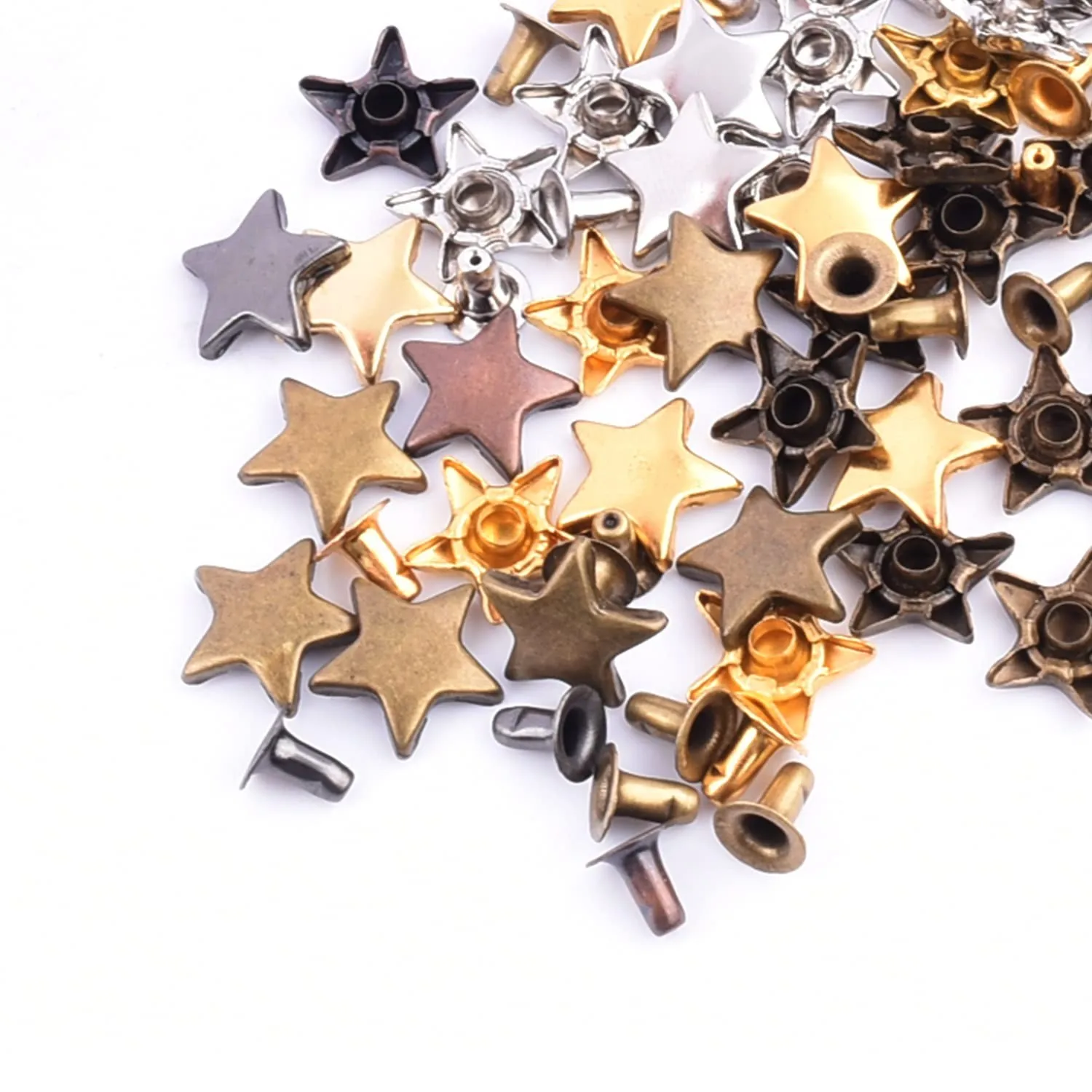
Solid brass rivets and decorative studs in gunmetal, antique brass, silver, and gold finishes — the kind of bulk variety you’ll evaluate when sourcing.
1. The Four Rivet Types — Only One Survives a Dog Collar
Here’s the single most important thing the Reddit community agrees on, and I’m going to say it in bold because Marcus insists: if your product takes any kind of load — pulling, twisting, weight — you use solid brass rivets with burrs. Period.
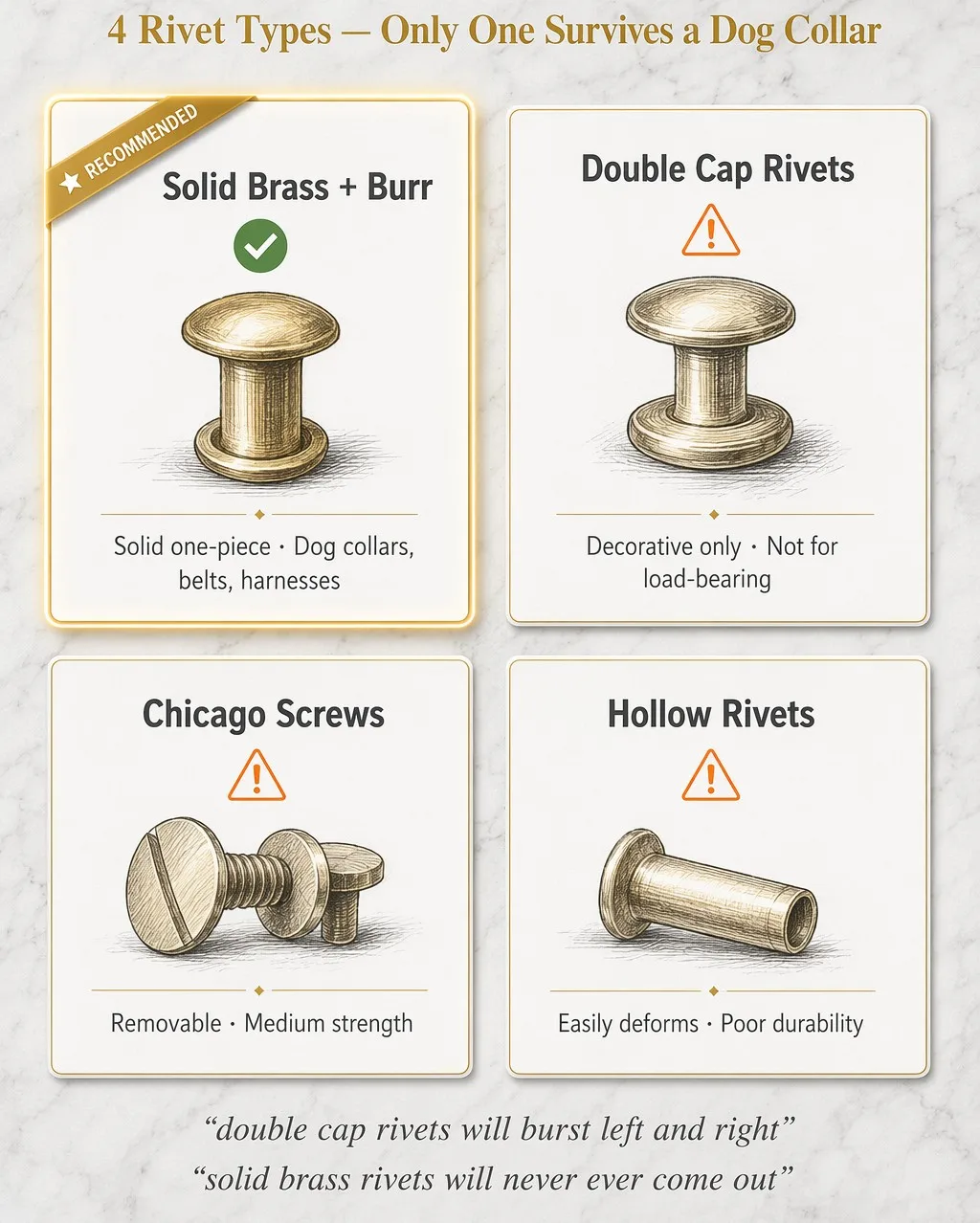
Community consensus, visualized: solid brass + burr is the only type rated for load-bearing applications like dog collars and belts.
|
Type |
Construction |
Strength |
Use Case |
Bulk Verdict |
|
Solid Brass + Burr |
Solid post, separate burr washer, peened end |
★★★★★ |
Dog collars, belts, harnesses, armor, any load-bearing point |
Buy this. This is the one. |
|
Double Cap Rivets |
Hollow post, two decorative caps press-fit |
★★☆☆☆ |
Wallets, card holders, decorative-only positions |
Fine for non-stress decoration. Never for structural. |
|
Chicago Screws |
Threaded post + screw, removable |
★★★☆☆ |
Belt Buckles needing removal, adjustable gear |
Niche — only if removability matters. |
|
Hollow / Tubular Rivets |
Hollow cylindrical body, flared end |
★★☆☆☆ |
Light-duty, rarely discussed by pros |
Avoid for any serious work. |
“I had a wholesale customer return 80 dog collars because the double-cap rivets popped at the D-ring. Eighty collars. I switched to solid brass burr rivets the next day and never had a return since. That one mistake cost me $2,400 in refunds and a retail account.”— Marcus Harlow
⚠ The #1 Newbie Trap
Don’t confuse “brass finish” with “solid brass.” Brass-plated steel rivets will corrode, flake, and fail. When you’re ordering in bulk, always specify “solid brass” in your RFQ. The price difference is real, and so is the durability gap.
2. The Sizing Formula That Ended Every Argument in My Shop
Elena Vasquez has sourced hardware from factories across three continents. She’s seen every spec sheet format known to man. Here’s her take on the sizing question that haunts every new maker:
“The Reddit community landed on a formula that matches what I’ve seen in factory technical sheets for decades: Rivet Length = Leather Thickness + 1.5 × Shank Diameter. It’s not complicated. The problem is that most people never measure their leather stack before ordering.”— Elena Vasquez, Hardware Sourcing Specialist (12 years)
|
Rivet Size |
Head Diameter |
Shank Diameter |
Typical Post Lengths |
Best For |
|
#9 |
~7.9 mm (5/16″) |
~2.8 mm |
8 mm – 25 mm |
Wallets, card holders, small leather goods, light armor accents |
|
#12 |
~9.5 mm (3/8″) |
~3.2 mm |
10 mm – 32 mm |
Belts, dog collars, harnesses, heavy armor, structural joints |
Elena’s bulk-order sizing rule: Order your rivets 2 mm longer than the formula says. You can always trim the excess post after setting. You can’t stretch a rivet that’s too short. For production shops, this is the difference between zero waste and a box of unusable hardware.
Real-World Thickness Reference
|
Leather Type |
Thickness |
Recommended Post Length |
|
Wallet / card holder leather (3–4 oz) |
1.2–1.6 mm |
8–10 mm (#9 or #12) |
|
Belt leather (8–10 oz) |
3.2–4.0 mm |
12–14 mm (#12) |
|
Heavy saddle / armor leather (10–17 oz) |
4.0–6.8 mm |
16–25 mm (#9 dome head, 1″ post) |
|
Multi-layer stacks (3+ layers) |
Up to 16 mm |
19–25 mm (3/4″ to 1″ solid brass) |
3. Bulk Buying: What Nobody Tells You Until It’s Too Late
This section is pure Elena. She’s negotiated millions of units of hardware from factories in Asia, Europe, and North America. Here are her non-negotiable parameters for anyone ordering brass rivets by the thousand.
Material Grade Spec
C27000 or C28000 Brass (≥ 60% Copper)
Anything below 58% copper is technically brass but will behave more like zinc alloy — brittle, dull, prone to cracking during peening. Always ask for the alloy grade in your RFQ.
Lead Content
< 100 ppm (Low-Lead Compliant)
Essential for any product sold in the US or EU. Low-lead brass is the standard for consumer goods. If your supplier can’t provide a lead-content certificate, walk away.
Burr Tolerance
± 0.05 mm (Post-to-Burr Fit)
The #1 quality complaint on Reddit: burrs that are too loose (rivet won’t lock) or too tight (post bends during setting). Demand a tolerance spec. A reputable factory can hit ±0.05 mm.
Elena’s Bulk Order Checklist
Request a pre-production sample of 20–50 pieces before committing to 10,000+
Ask for the alloy grade certificate (C27000 minimum, ≤100 ppm lead)
Specify post-diameter tolerance and burr inner-diameter tolerance in the same RFQ
Confirm packaging: bulk bag vs. compartment tray — trays eliminate mixing of washers
Always order 5% extra burrs — they get lost easily
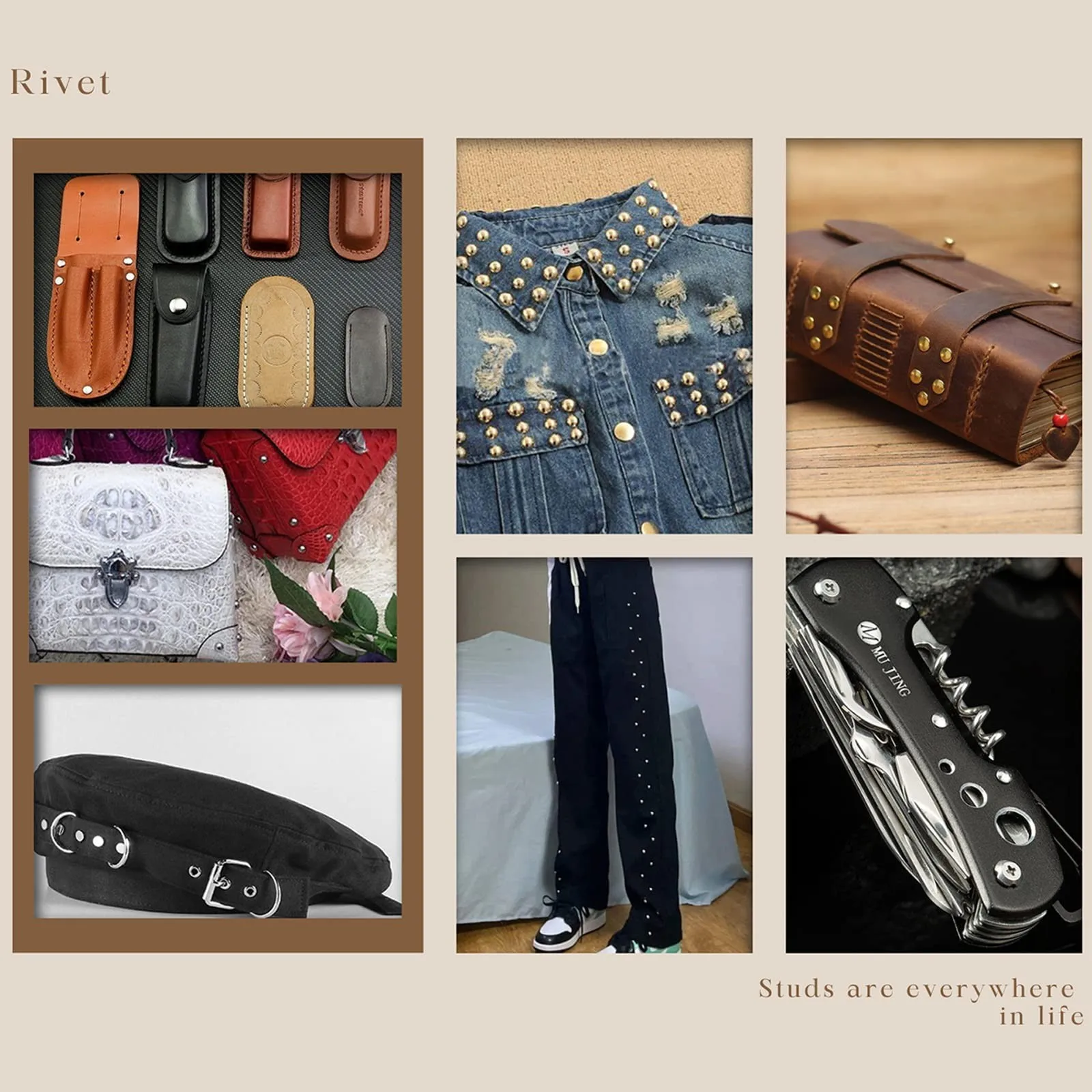
Rivets are everywhere: from leather sheaths and handbags to journals and gear.
4. How to Set Solid Brass Rivets & Tool Recommendations
Tomás Bergström builds saddles and equestrian gear in Colorado. Here’s his process and essential tools developed over 18 years.
The three tools every production shop needs, plus troubleshooting common failures.
|
Tool |
What It Does |
Production Recommendation |
|
High-Leverage Cutters |
Trims brass post to length before peening |
Compound-leverage 8″ handles (e.g. Knipex or Farrier nippers). |
|
Rivet Setter + Base |
Holds rivet head steady and aligns post |
Must match exact rivet size (#9 or #12). |
|
Arbor Press (1–2 ton) |
Replaces hammer for even pressure |
Recommended for 500+ rivets/month to eliminate bent posts. |
Frequently Asked Questions (FAQ)
Q: Can I use double cap rivets for load-bearing dog collars or belts?
A: No. Double cap rivets are press-fit and decorative; they cannot handle tensile stress. For load-bearing products like dog collars, belts, and harnesses, you must use solid brass rivets with burrs.
Q: What is the difference between #9 and #12 brass rivets?
A: #9 rivets feature a ~7.9mm head diameter and ~2.8mm shank, ideal for wallets and small leather goods. #12 rivets feature a ~9.5mm head diameter and ~3.2mm shank, designed for heavy-duty collars, belts, and structural joints.
Q: What brass alloy grade should I request in an RFQ?
A: Always specify C27000 or C28000 Solid Brass (minimum 60% copper content,
Q: What tool should I use to trim solid brass rivet posts?
A: Use 8-inch high-leverage compound cutters (such as Knipex) or farrier nippers. Standard wire cutters or pliers are not strong enough for solid brass and will cause hand fatigue.
Quick Reference: Spec Sheet for RFQs
Copy these parameters into your next Request for Quotation (RFQ):
|
Parameter |
Recommended Value |
|
Material |
Solid Brass — C27000 or C28000 (≥60% Cu) |
|
Lead Content |
< 100 ppm (REACH / CPSIA compliant) |
|
Rivet Size |
#9 (7.9 mm head) or #12 (9.5 mm head) |
|
Post Length Range |
8–32 mm (specify 2–3 lengths per order) |
|
Post Diameter Tolerance |
± 0.05 mm |
|
Burr ID Tolerance |
± 0.05 mm (matched to post OD) |
|
Packaging |
Compartment tray or labeled bulk bag |
Sources & Community Threads
This guide compiles discussions from r/Leathercraft, r/Leatherworking, r/metalworking, r/Blacksmith, r/sca, and r/Tools, validating specs with industry experts.
About Us
Our company named Dongguan King Ming Hardware Co., Ltd. was founded in 2000, which is a professional manufacturer with more than 23 years of rich experience. We specialize in letter buckle, D ring, O ring, Hook for bag, handbag label, belt buckle, Zipper, Key Chain, metal Eyelet, Bag Handles Kiss Lock and pet hardware, and so on
Media Contact
Company Name: Dongguan Kingming Hardware Plastic Technology Co., Ltd.
Contact Person: Media Relations
Email: Send Email
Country: China
Website: https://www.kmhardware.com/
Press Release Distributed by ABNewswire.com
To view the original version on ABNewswire visit: Solid Brass Rivets with Burrs Buyer’s Guide: Sizing, Specs & Sourcing


