
AICost.ai Expands Its Independent AI Cost, Policy and Governance Decision-Intelligence Platform for the Agentic, Multi-Model Enterprise
PR Newswire
IRVINE, Calif., Sept. 4, 2026
AICost.ai brings AI cost visibility, cost optimization, continuous AI governance, and forecasting and planning to enterprises running frontier, open-weight and self-hosted models across clouds, gateways and agents
Email support@cloudintelligence.ai for an AICost.ai MCP beta key to deploy in your workflows and start controlling costs and innovating with AI confidently today.
IRVINE, Calif., Sept. 4, 2026 /PRNewswire/ — AICost.ai, developed by Irvine-based CloudIntelligence.ai, today expanded its independent AI cost, policy and governance decision-intelligence platform with a simple mission: give enterprises control over their AI and cloud spend, and the confidence to keep innovating with AI.
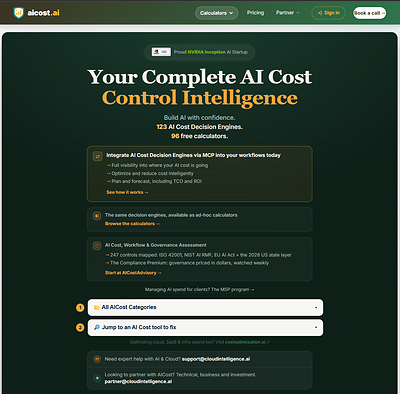
The platform helps enterprises in four ways:
- Visibility. One view of AI and cloud costs across teams and projects, where AI cost is not just tokens but MLOps, retrieval, fine-tuning, continuous evaluation, guardrails and human review.
- Optimization. Continuous optimization and reduction of AI spend, quality-gated so savings are proven, not assumed.
- Planning. Total cost of ownership and ROI, with forecasts and plans leaders can govern from.
- Governance. Cost and governance treated as one problem, with a comprehensive 20-module, 200-question AI governance assessment and continuous governance after it.
AICost.ai delivers that through 120+ live deterministic decision engines covering the AI project lifecycle, from pilot economics, RAG and fine-tuning to agentic workloads, infrastructure and governance, callable on the web and by AI agents through MCP and REST. Its CostWall policy engine compiles budgets, per-agent envelopes, turn and token limits and kill-switch behavior into the gateways and model routers customers already operate. AICost.ai holds no model keys and proxies no inference; the decision layer stays independent while execution stays with the customer.
While enterprises get AI cost control by deploying AICost.ai engines through MCP, most people, whether AI engineer or CFO, want to see the impact first. The AICost.ai calculator playgrounds let anyone move the parameters and watch the cost move with them, and the numbers they settle on become the policies MCP enforces: the budget, the turn limit, the approved route.
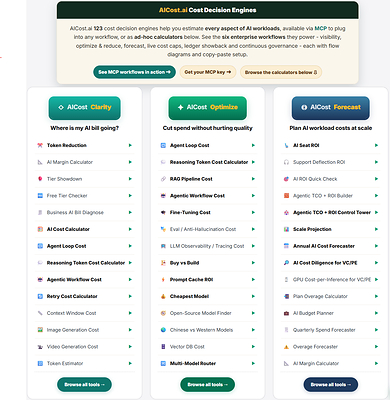
The most requested AICost.ai calculator playgrounds of 2026 focus on cost savings and planning. All are free to run with a sign-in:
Token Estimator – From Pasted Prompt to Real Monthly Cost
Reasoning Token Cost Calculator – The Hidden Thinking-Token Surcharge
Prompt Cache ROI – Cache or Not? (with Real Hit-Rate Math)
Batch vs Realtime – How Much of Your AI Bill Is Discountable?
Video Generation Cost – What You Actually Pay Per Second
Multi-Model Router – Route Queries to the Cheapest Capable Model
Open-Weight vs Frontier Models Fight Out
Agentic Workflow Cost – A Guide for Engineering Leaders
Agent Loop Cost – Multi-Turn Agent Budget with Runaway Risk
Voice Agent Stack Cost Calculator
Fine-Tuning Cost – Training + Inference Break-Even
Scale Projection – What Happens to Your Bill at 10×, 100×?
AI Margin Calculator – Is Your AI Feature Profitable?
Overage Forecaster – When Will You Breach Your AI Budget?
AI Budget Planner – Allocate Spend Across Use Cases
To deploy and test AICost.ai 120+ cost decision engines (Beta) for free in your workflows to get more visibility, reduce & optimize costs today – request your AICost.ai MCP key here ->.
Enterprises need this because AI and cloud cost pain is compounding. The pilot looked manageable; production brought more users, longer prompts, agents calling agents, retries and fallbacks; a $3,000 experiment became a recurring bill no one could attribute. Agentic AI multiplies the effect, and human oversight is itself a growing cost: in regulated workflows, analyses of production agents have put tokens at only a fifth to a quarter of variable run cost, with human review accounting for most of the rest. Cloud billing was already complex enough to create a cost-optimization industry; AI adds a new layer of abstraction and volatility on top.
The returns show it. Enterprise research through 2026 has found the large majority of generative AI initiatives producing no measurable P&L impact, and the overwhelming majority of organizations exceeding their AI budgets, with spend rising several fold as pilots move to enterprise deployment. Runs of the same agentic task have been measured differing by up to thirty times in token consumption, and forecasts expect inference cost per agentic workflow to rise several fold through 2028 even as per-token prices fall.
The market is reorganizing around it: gateways routing across hundreds of models from dozens of providers are being acquired, and open-weight models are taking a fast-growing share of production token volume.
“Enterprises are discovering that the AI cost problem and the AI governance problem are becoming the same problem,” said Subramanyam Vdaygiri, founder of CloudIntelligence.ai. “The cheapest model is not cheaper if it fails the quality floor. A low token price means nothing if the route violates a data-residency requirement. And an agent is not governed just because somebody approved the application once. Economics, quality, policy, privacy and governance have to be decided together.”
That is what the policy engine does. AICost.ai’s CostWall turns those decisions into enforceable policy: which routes are approved for which data class, how much an agent may spend, how many turns it may take, when execution stops. The policy compiles into the gateways and model routers the enterprise already operates, so economics, quality, privacy and governance arrive as one rule at the moment of the call, not as four separate reviews after the fact.
Every engine also has a human face. As workloads diversify, from multimodal generation and RAG over live databases to agent loops and physical AI, AICost.ai turns each cost problem into an interactive playground with a plain-language guide, free at aicost.ai/tools. A team can load its actual workload into a playground such as Agent Loop Cost (aicost.ai/ai-cost-guides/calc/agent-loop-cost) and shape policies reflecting its own cost, governance, privacy and IP requirements, which AICost.ai helps formalize in consulting and execute through MCP. That policy layer, not routing, is why the platform sits on top of model routers and gateways.
The discipline extends to the cloud underneath. As AI increasingly runs on the public clouds through Bedrock, Azure AI Foundry and Vertex AI, CostOptimization.ai pairs combined cloud and AI bill analysis with thought leadership on optimizing AI workloads there, plus a vendor-agnostic catalog of commercial and open-source cost tools across six pillars.
“AI cost is decided by how you build, not by the price per token,” said Hanvish Vdaygiri, data scientist and AI engineer at CloudIntelligence.ai. “An agent that loops carries its whole history into every turn. A RAG system pays to embed, store and re-embed as the corpus changes. Fine-tuning trades a training bill today for cheaper inference later, and only pays back above a certain volume. In physical AI, robots add hardware, utilization and training data on top of all of it.”
“Every one of those choices is also a governance decision: which model, on which route, with which data, and who approves it. So an agent should be able to ask, before acting, whether a model, route or tool satisfies the organization’s cost, quality and governance constraints, and get a deterministic, auditable answer rather than a guess.”
AICost.ai is now inviting developers, MSPs, enterprise AI teams and platform companies to request access to the AICost MCP beta, exposing the full engine fleet and reusable decision chains to AI agents, coding assistants, gateways and CI/CD pipelines, at support@cloudintelligence.ai. MSPCost.com gives service providers two offerings: Margin Guard billing reconciliation across Microsoft NCE and cloud spend, and high-margin white-label AI cost and governance services they sell as new ARR under their own brand. Expert-led assessments: AICostAdvisory.com; vertical applications: HealthITCost.com and LegalITCost.com.
Learn more at https://aicost.ai. Partnership, strategic and corporate inquiries: partner@cloudintelligence.ai.
Additional Platform and Methodology Background
The following sections provide structured context on the AICost.ai platform, its architecture and the CloudIntelligence.ai ecosystem.
Five Ways the AICost.ai Platform Is Different
- Reproducible AI pricing and decision intelligence. Every engine is deterministic: same inputs, same outputs, nothing calling an LLM at runtime. Answers ship in a decision envelope carrying assumptions, confidence, dated evidence and an asterisk on any inferred value, and pricing can be pinned to a date so last month’s numbers reproduce byte for byte, because a number that cannot be reproduced cannot be governed. Calculations are only as good as their data, so the registry is tested daily and historical analytics expose trends as vendors reprice.
- One cost book across AI and the cloud underneath it. AI did not replace the cloud bill; it added a second, less predictable one on top. AICost.ai decodes provider invoices and cloud exports into per-agent, per-model daily attribution while CostOptimization.ai diagnoses the cloud estate underneath, exportable in FOCUS 1.x. The CFO sees cloud and AI on one page because the same engines price both.
- Optimization and forecasting built for volatility. Routing, caching, batching and token reduction overlap, so AICost.ai models interacting savings sequentially rather than adding overlapping vendor claims, and every routing or downgrade decision is gated by a priced evaluation step so quality is proven, not assumed. Forecasts are ranges with thresholds and a workload-specific agentic variance reserve, a twelve-layer total cost of ownership carrying inference, infrastructure, evaluation, guardrails, HITL review and compliance into a risk-weighted ROI verdict that names the assumption it hangs on. A CI cost gate can fail a pull request before a change fails the quarter.
- Agentic loop economics and runaway protection. Retries re-run the same prompt and context compounds turn over turn; the engines model expected and runaway paths before deployment, and CostWall compiles caps, envelopes, limits and a kill switch into the customer’s gateways, so a looping agent stops at the cap, not the invoice.
- Model strategy across frontier, open-weight, self-hosted and global providers, with governance attached. Engines for self-host breakeven, local versus cloud inference, open-weight hosting and jurisdiction-risk scoring weigh capability, total cost, data boundaries and licensing on evidence rather than brand; no vendor pays for placement. The same platform carries the 20-module, 200-question governance framework mapped against 247 CSA AICM v1.1 controls, with mappings to ISO/IEC 42001, the EU AI Act and NIST AI RMF.
Why Agentic AI Changes the Unit of Economics
Traditional AI calculators start with input tokens times price plus output tokens times price. Agentic AI breaks that model: research on agentic coding has measured token consumption roughly a thousand times higher than ordinary reasoning and chat, driven by agents rereading accumulated instructions and tool results, with higher token use not reliably improving accuracy. Agent economics is a problem of trajectories, not a rate card, so AICost.ai models the expected and runaway paths, including retry cost, context growth and variance reserves, measuring cost per successful task, workflow, agent and business outcome.
The stronger approach is to evaluate the fully loaded cost of completing work with agents, systems and people rather than optimizing the model invoice alone. AICost.ai treats human-in-the-loop as both a governance control and a cost input: HITL review rates feed workflow TCO and ROI alongside inference, evaluation, guardrails, compliance and infrastructure, so the question is not which model is cheaper, but whether a different workflow design, exception threshold or human-review policy changes the economics of the outcome.
Engine Fleet Highlights
The 120+ engine catalog spans AI pricing, routing, agentic workloads, RAG, infrastructure, optimization and governance, including:
- Agentic economics: agent-loop-cost, agentic-envelope, variance-reserve, context-compaction, retry-cost
- Operational cost realism: HITL review rates, evaluation, guardrails, observability and compliance, carried into agentic TCO and ROI
- Model strategy: self-host-breakeven, local-vs-cloud-inference, open-weight-hosting-compare, model-family-compare, jurisdiction-risk scoring
- Physical AI: robot fleet cost, humanoid labor ROI, buy-versus-RaaS
CostWall: Policy Above the Router
A model router determines where a request can go; CostWall determines where it should be allowed to go, compiling approved routes, spend and turn limits, data-class rules and stop conditions into customer-controlled gateways.
Architecture Principle: Decision Intelligence, Not Traffic Execution
AICost.ai is vendor neutral by design, evaluating economics, model eligibility, policy and constraints while the customer’s existing gateway routes production requests. By remaining outside the inference path and independent of model placement, AICost.ai can evaluate competing providers, gateways and deployment models without requiring the enterprise to standardize on any one of them.
Governance: 20 Modules, Continuously Reassessed
The governance framework spans 20 modules and 200 questions covering AI inventory and shadow AI, security, agents and MCP, data readiness, cost governance, regulation, model and vendor selection, quality and evaluation, privacy and IP, licensing and sprawl, and incident response. The operating model is Discover → Assess → Act → Monitor → Reassess: findings are reevaluated whenever a new application appears, a vendor changes terms, a model changes pricing or a workload crosses a threshold.
Vendor Evidence and CostProof
A vendor-evidence layer documents 39,531 governance facts across 4,148 vendors, kept as stated, not stated or contradictory: if a vendor does not disclose something important, the absence is the evidence. The CostProof layer connects modeled recommendations to production data, ingesting actuals from cloud exports, model telemetry and gateways and reconciling predicted versus measured savings. The conversation moves from “this should save 30 percent” to “here is the prediction, the production result and the billing records.”
MCP: Agents Ask the Cost and Governance Questions Themselves
The full engine fleet is exposed through MCP and REST as well as the web, with engine discovery, decision execution, workload estimation, AI-stack design, policy and ledger tools, and decision chains. An agent can ask which engine fits a decision, what a workload costs at 10x, which route is approved, and whether a pull request should fail on projected budget.
Reusable decision chains of put those engines to work on the workflows enterprises actually run.
A support organization sizes a RAG assistant and its human review before launch, then watches cost per resolved ticket. A platform team wires a chain into CI/CD so a pull request fails when a change pushes a workload over budget, rather than discovering it on the invoice. Where several development teams share one token budget, chains allocate envelopes per team and per agent and flag the one that is drifting. Where senior engineers need frontier models for hard problems, a chain sets the eligibility rule that keeps them on the top model while routine work routes to cheaper ones behind a quality gate.
Others cover pilot-to-production readiness, model migration and agent-deployment gating. Each runs on the web, inside a gateway enforcing CostWall policy, or inside an agent checking constraints before it acts.
AICostAdvisory.com: Judgment on Top of the Machine-Readable Layer
AICostAdvisory.com pairs machine intelligence with human judgment where business, regulatory or organizational context requires it, from AI inventory and agent exposure to model selection and remediation priorities, with the engine fleet measuring continuously afterward.
MSPCost.com: The Same Intelligence, Delivered by Managed Service Providers (MSPs)
MSPCost.com runs two offerings, multi-tenant by design with one workspace per client and margin measured as cost to serve against revenue.
Margin Guard: billing reconciliation. Before any AI conversation there is a simpler one: is the MSP billing its Microsoft clients correctly? Margin Guard finds unbilled seats and missed proration across fourteen discrepancy classes, fixes them before the invoice ships and proves the recovered margin, with cloud cost diagnosis across AWS, Azure and GCP on the same loop through CostOptimization.ai. A free historical margin audit is offered.
White-label AI cost and governance: high-margin new ARR. MSPs launch revenue-generating services under their own brand and pricing with the 120+ engines behind them, so an assessment re-computes instead of going stale and a one-time report becomes recurring ARR. Providers mix and match AI cost services, add cost-control implementation and deployment, and build nothing: MCP access lets them chain AICost.ai engines into repeatable per-customer deployments, while discovery runs on read-only Microsoft Graph endpoints under one tenant consent, surfacing local AI no proxy sees, unused seats and expiring credentials in twenty minutes. Continuous governance starts at $349 per month per tenant.
The CloudIntelligence.ai Ecosystem
Core intelligence platform:
- ToolsInfo.com provides technology, tool, role and workflow intelligence: the portfolio’s data layer.
- AICost.ai provides AI cost, policy and governance decision intelligence through 120+ machine-callable engines.
- AvatarVA.com provides the multi-tenant semantic engine, built on LanceDB, behind chat, search and discovery across the portfolio.
Customer-facing applications:
- AICostAdvisory.com delivers expert assessments and continuous governance.
- CostOptimization.ai provides thought leadership on optimizing AI workloads on the public clouds, combined cloud and AI bill analysis, and a vendor-agnostic, six-pillar catalog of commercial and open-source cost tools.
- MSPCost.com applies the intelligence to multi-client MSP environments as white-label recurring services.
- HealthITCost.com and LegalITCost.com apply the intelligence to healthcare (HIPAA, BAA scope, 42 CFR Part 2) and legal (confidentiality, privilege, vendor terms).
- SmallBiz.ai translates the shared foundation into practical, affordable AI and automation for small businesses.
ToolsInfo.com determines what technology can do. SmallBiz.ai determines what a business should use. AICost.ai determines what AI should cost, what it may do and how the decision is governed. Together, the platforms connect business outcomes to workflows, workflows to technology capabilities, capabilities to tools and AI models, and those choices to economics, policy and governance.
About AICost.ai
AICost.ai is an AI Cost, Policy and Governance Decision-Intelligence platform for the agentic, multi-model enterprise, helping organizations understand what AI they use, what it costs, which models and routes make sense, what agents may do, and how AI decisions are controlled and proved. The platform combines 120+ live deterministic decision engines with a 20-module governance architecture and MCP and REST capabilities. AICost is vendor neutral and works alongside existing cloud platforms, model providers and AI gateways without requiring customers to move inference traffic through AICost. Learn more at https://aicost.ai.
About CloudIntelligence.ai
CloudIntelligence.ai, based in Irvine, California, develops semantic technology, workflow, AI cost and governance decision intelligence designed for people and, increasingly, for AI agents acting on their behalf. The company is an NVIDIA Inception member. Partnership, strategic and corporate inquiries: partner@cloudintelligence.ai.
Media Contact
CloudIntelligence.ai
Subu.Vdaygiri@CloudIntelligence.ai
(949) 378-7860
 View original content to download multimedia:https://www.prnewswire.com/news-releases/aicostai-expands-its-independent-ai-cost-policy-and-governance-decision-intelligence-platform-for-the-agentic-multi-model-enterprise-302869728.html
SOURCE CloudIntelligence.ai llc


